

Composer Versus World
Ed Bennett: My Broken Machines
Decibel, Fidelio Trio, ConTempo Quartet, Garth Knox, Paul Roe
NMC [D169]
Purchase
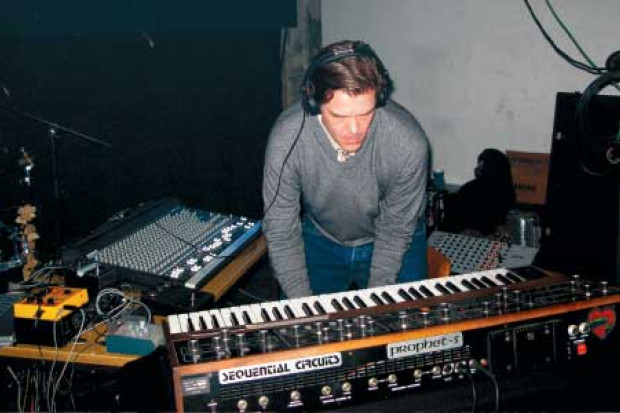
Finding Ed Bennett’s music, even with his new album to hand, is not an altogether straightforward task. This is not due to a lack of vitality, or of invention – the seven pieces of My Broken Machines exhibit these qualities unceasingly – but because his music is made up almost exclusively of paraphernalia. Scratches, de-tunings, key clicks (the mind-clutter of the musician), assert themselves in the foreground as seemingly immovable objects; as does marginalia of a more generic kind, with the bastard offspring of venerable forms, sound effects, cartoon music, fairground muzak and the like, providing the subject matter for most of these – sometimes grotesque – essays on modern noise.
But then, as the pieces unfurl, and Bennett’s craft embeds itself in the listener, a vision more human than mechanistic asserts itself. Through the obsessively repetitive fragments of Stop-Motion Music or the interruptive bolts of the title track the struggle to perceive a disintegrated world becomes the challenge, not the appreciation of process for its own sake. It’s also a pleasure to hear how Bennett, working also as director and co-producer, has so completely persuaded his performers of the validity of the project. Decibel, formed by the composer in 2003, is an ensemble that seems to feel this music, as if through instinct, and the ConTempo String Quartet and the Fidelio Trio bravely break out of their formal confines, leaving only a glimmer (but a glimmer nonetheless) of their classical selves.
Best of all, and this again speaks of Bennett’s complex but direct emotionality, are the two solo pieces, Monster for bass clarinet and tape and Ghosts for amplified viola d’amore. In the respective cases Paul Roe and Garth Knox, always the most vital and nuanced of performers, work through the imposed asceticism of the composer to produce statements that, if not liberated exactly, always promise that the world is there to be overcome.
Published on 28 June 2011
Peter Rosser (1970–2014) was a composer, writer and music lecturer. He was born in London and moved to Belfast in 1990, where he studied composition at the University of Ulster and was awarded a DPhil in 1997. His music has been performed at the Spitalfields Festival in London, the Belfast Festival at Queen’s and by the Crash Ensemble in Dublin. In 2011 the Arts Council acknowledged his contribution to the arts in Northern Ireland through a Major Individual Artist Award. He used this award to write his Second String Quartet, which was premiered in 2012 by the JACK Quartet at the opening concert at Belfast's new Metropolitan Arts Centre (The MAC). Peter Rosser also wrote extensively on a wide range of music genres, with essays published in The Journal of Music, The Wire, Perspectives of New Music and the Crescent Journal. He died following an illness on 24 November 2014, aged 44.